Tuesday, March 3, 2015

Want All The Things


I'm such a good little Disney consumerist. These appeared on the Disney Store website today:


They're Frozen-themed Tsum Tsums. 

To be honest, I'm not sure I even know what a Tsum Tsum is. I think they're supposed to be cute, squishy, and, for some reason, stackable plush...things. And they are cute. But I didn't quite understand the "craze" that Disney was trying to incite. 

But then they released Anna and Elsa and Sven and...I want them. Even Olaf and Kristoff are adorable! Hans...well, he's Hans. He rounds out the pyramid, I guess. 

Monday, March 2, 2015

Cinderella on the Brain

With the live-action adaptation of Disney's Cinderella hitting theaters in just a couple of days, Cinderella seems to be everywhere.

A couple of days ago, Duke University's Facebook page posted a link to the following: an interview with Assistant Professor of Sociology (at Duke) Jessi Streib, titled "What Happens When Rich People Marry Poor People."


The article is an interesting read -- and it comments a lot on class divisions and gender roles, something I'm always fascinated by. 

But I'm not blogging about the content -- I'm not a sociologist, and, regardless, I don't disagree with her conclusions; on the contrary, I find them really interesting.

But I am a children's literature/Disney scholar, and so what piqued my interest was the decision to put the disney photo of Cinderella and Prince Charming underneath the article title. As far as I can tell -- since there's no mention of Disney or Cinderella in the interview -- the implication is that the "rich people" are represented by Prince Charming and the "poor people" are represented by Cinderella. After all, the story of Cinderella is often referred to as a rags-to-riches story wherein the penniless scullery maid rises through the ranks to marry the eligible and charming prince. 

But...here's the thing that gets me: Cinderella may be penniless, she may be a maid, and she may sleep in the attic and sit in the ashes but she's not from the lower class. 

The "original" version by Perrault is a little vague on the subject -- depending on the translation, her father is either a "gentleman" or a "worthy man." Her stepmother is described as a proud and haughty woman and the family is obviously well-enough off to afford rich clothes and jewel suitable for balls at the palace. Similarly, in the Grimms' version, the father is described as a "rich man." 

Then, in the 1950 Disney version, the film opens while Cinderella's father is still alive: the storybook narrator tells us that, "Here, in a stately chateau, there lived a widowed gentleman and his little daughter, Cinderella. Although he was a kind and devoted father, and gave his beloved child every luxury and comfort, still he felt she needed a mother's care. " 

So, here's the thing -- and one of the things that always bothers me about adaptations of Cinderella -- if Cinderella's father is rich and is a gentleman, then Cinderella is the daughter of a rich man and a gentleman. Until her father remarries, she grows up in a pretty luxurious atmosphere -- she's not royalty, but she's most likely a member of the nobility or the upper-class. 

But that fact seems to get lost in adaptation -- and it's always bugged me. 

Take Ever After (1998) for instance. I loved this movie when it came out -- heck, I still do: Drew Barrymore as a feistier, hard-working Cinderella who reads? Da Vinci as her fairy godmother? Yes, please. The plot hinges on the fact that Danielle (as Cinderella is called here) poses as a noblewoman to get her servant back (long story). She gives her mother's name -- and her mother was a countess. But somehow, even though her mother was a countess, Danielle is still considered to be a serving girl -- and hijinks straight out of Pride & Prejudice ensue, resulting, of course, in a happily ever after. It's true that her father isn't really referred to as a count -- just her mother as a countess. And it's true that her stepmother (played by the incomparable Anjelica Houston) seems to be a Baroness in her own right. So maybe Danielle's parents were of different classes -- the countess married someone well beneath here and was hence stripped of her title. But the chateau that Danielle lives in -- her family home and estate -- doesn't really reflect that. 

So maybe I'm missing some integral part of French class divisions -- that a daughter is stripped of her titles and status when her father dies. But...that seems odd. 

In all of these versions, Cinderella is born into the upper-class -- and so, to me, her marriage to the Prince can't represent an inter-class marriage. Yes, her evil step-family treats her horribly: they psychologically abuse her; they degrade her and relegate her to the position of servant; they ostracize her from the family dynamic. Does that mean she's not still a member of the upper-class? Technically, perhaps. But in spirit? No.

And isn't that the point of Cinderella? Especially of the 1950 version? That even though she's fallen from her position of privilege, even though she's serving the people who are supposed to be her family, even though life has thrown her some horrible curveballs, Cinderella's kindness and sweetness and goodness triumph over all. She's defined by her heritage and her birth and her parents' -- particularly her mother's -- legacy, not through current circumstances. And when the Prince falls in love with her and they get married, it makes sense: they are both good, kind, upper-class people so of course they should end up together. 

Disney's Cinderella has got a lot going on -- particularly with regards to heteronormative gender roles and the stoic passivity with which Cinderella accepts horrible treatment. But, it was released in 1950, and things were different. But introducing class into the movie...I'm not sure that's a fair criticism. After all, Disney's narrator explicitly states that Cinderella's father, for his second wife, chooses a "woman of good family" -- which I take to mean "good breeding" which in turn implies "upper class." So class doesn't really come into play here: our heroine's a member of the upper-class as is our villain. 

If Cinderella had been an actual servant who rose through the ranks -- if she hadn't been a step-daughter -- then we might have a rags-to-riches story. Given the title of the article, there are a couple other Disney movies that would have been more appropriate. 

Like, for instance,  Beauty and the Beast: Belle grows up in a small provincial town (we're hit over the head with that, aren't we?) but she eventually marries the Beast, who is, in fact, a prince. Inter-class marriage.

In Aladdin, Aladdin is literally a street rat, the diamond in the rough. But he eventually marries Princess Jasmine. Inter-class marriage.

In Tangled, Flynn is literally a thief. But he eventually marries Princess Rapunzel. Inter-class marriage.

And in The Princess and the Frog, Tiana works not one, but two, jobs to raise enough money to open her own restaurant. But she marries Prince Naveen in a -- you guessed it -- inter-class marriage. 

If you want to include a picture from a Disney movie in an article about marriages between rich people and poor people, I'm not sure Cinderella was the best choice here. Yes, it's the quintessential rags-to-riches story, but, if you think about, it's actually more of a riches-to-rags-to-riches story. I have a feeling that Cinderella and Prince Charming would probably not have the same fights and discussions in their marriage that Aladdin and Jasmine or that Tiana and Naveen would have. 

But, of course, they all lived happily ever after so class differences probably don't matter for them.

Friday, February 27, 2015

Love Pocket Princesses

One of my favorite Disney fan pages to follow (on Facebook) is Pocket Princesses by Amy Mebberson.

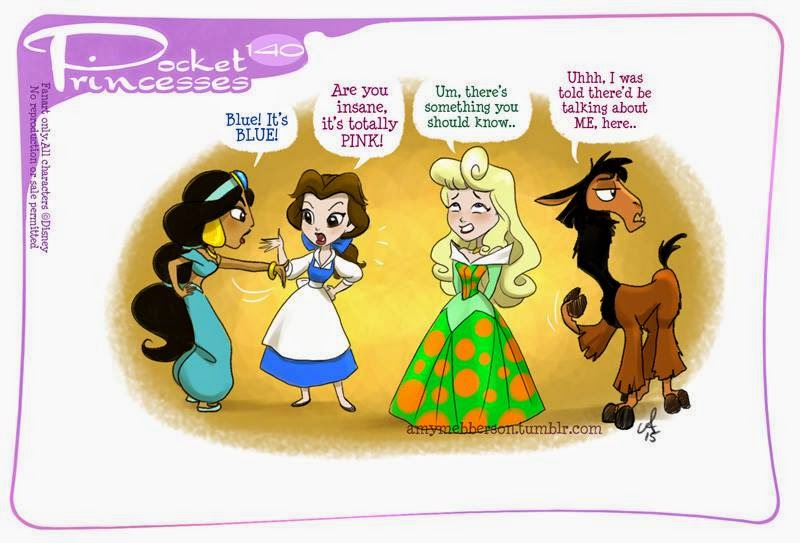
I had to share the picture she drew & uploaded today:


I'll admit -- I don't always understand them, but this one was hilarious, given the Internet's freakout over The Dress and The Llamas. This just worked brilliantly and hats off to Amy Mebberson.

For the record -- I saw white and gold, but my husband saw blue and black. Well, actually, he saw blue and brown, but close enough. Fascinating, but I feel like Taylor Swift's tweet accurately sums up my feelings:


Wednesday, February 25, 2015

Frozen Fever Trailer!


Exciting news today -- and not just the fact that central North Carolina could get up to a foot of snow.  Elsa certainly has been busy because the Frozen Fever trailer is here!


While I'm a little skeptical about the new song (just because I haven't heard it in its entirety yet), I'm already counting down the days to March 13. 

Things we learned from the trailer:

1. Anna still wins at life by accurately depicting what girls look like when we wake up in the morning. And Elsa is absolutely adorable -- and I love that this moment reverses the scene from the film when Anna wakes up Elsa -- "the sky's awake, so I'm awake!"

2. Olaf sneaks a piece of cake and the entire world smiles. 


3. Sven is still the greatest character in the movie. And quite possibly the best Disney animal sidekick EVER.

4. Anna & Elsa *finally* get to ride their bikes around the halls. 

5. Oaken returns! I wonder if his "family dynamic" will be addressed...? 

6. There are little tiny snowmen. Let the merchandizing commence.


Tuesday, February 24, 2015

EPCOT Flower & Garden's Topiaries

Confession: Before my husband took me to Disney World over Fall Break on our first trip, I had never been to the Food & Wine Festival at EPCOT.

A tragedy, I know.

Now, it's one of my favorite parts of visiting Disney in the fall (it's really hard to beat cooler temperatures and smaller crowds). But it can get a little crowded -- especially on the weekends, when the locals flood in.

But last year, when I went down to EPCOT both in March (for a conference) and again in May (for a friend's graduation/birthday celebration) I really enjoyed the Flower & Garden Festival. It's similar to Food & Wine, at least in the sense that both have themed topiaries and food stands. Obviously there are many more food stands at Food & Wine, but the ones at Flower & Garden made a good showing.
(Exhibit A: Frushi -- Fruit Sushi:


But the topiaries. Oh, they're gorgeous.  This is my favorite from last year -- Tinkerbell by the Butterfly Pavilion:


But this year--this year there will, apparently, shockingly, be Anna and Elsa topiaries. The Disney Parks blog released the photos earlier today: 


There's a close-up of the Anna one at the website, but I omitted it here because it kinda freaks me out. It took me a minute to figure out why -- most of the topiaries, especially the human characters, don't have eyes. The animal characters (i.e., Mickey, Minnie, etc.) may have them, but the eyes....just seem a little unsettling here. 

Either way, I'm sure the topiaries will be beautiful. They always are. 


Monday, February 23, 2015

Disney's Oscar Wins

I love the Oscars. To paraphrase this year's host, the adorkable Neil Patrick Harris, there's something kinda awesome about lounging on the couch in your sweatpants, filling out an Oscar ballot, and live-texting the whole affair with your best friend.

And, last night, Disney won big:

First, "Feast" won Best Animated Short Film:

(c) Disney
Full disclosure: I have loved this short since I first saw the teaser for it. I mean, it's an adorable puppy and food -- these are a few of my favorite things. (Sidebar: Lady Gaga killed her homage to The Sound of Music. At first, I was all, "But Lady Gaga! As awesome as you are, this is Dame Julie Andrews' territory." And then literally 5 seconds later, I ate my humble pie. She was amazing. And then Dame Julie walked out, and they hugged, and there were tears on screen, and there were tears at home and...yeah.)

And then Disney won Best Animated Feature for Big Hero 6:


Which, I admit, I have not seen yet. It's on the list though -- maybe, if we get the snow that The Weather Channel is predicting Winter Storm Quantum will bring us, we'll have a Snow Day Movie Night. 

What's interesting to me is that, as Mae Anderson over at Yahoo points out, "[n]either film is connected to [Disney's] Pixar unit." Anderson also notes that, since Disney acquired Pixar in 2006, "the Disney Pixar combo had scooped up most animated feature Oscars," but I tend to think that a lot of that is Pixar's influence on Disney Animated films. 

[Sidebar #2: I'm not entirely sure that's fair. I probably -- unfairly? -- stereotype each animation studio in my mind: to me, Disney is the princess films and Pixar is more of a boy's club. (Purely animation--this is leaving out Marvel, Pirates, etc.) Disney tends to be more traditional, more heteronormative, more adapted stories; Pixar tends to be (theoretically) a little more progressive and a little more original. Again, I don't know if this is entirely fair, but films like Brave and Frozen seem to best represent the convergence of the two studios. Both are "princess stories" but are markedly different from earlier, Disney films like Tangled and The Princess and the Frog.]

I remember being very disgruntled two years ago -- during the 2013 Oscars when both Brave and Wreck-It Ralph were competing for Best Animated Feature. The Oscar ultimately went to Brave, a Pixar film. But I saw both films -- and I thought Wreck-It Ralph was far superior. While I appreciate what Brave did for the "princess story" genre, shifting the focus to a mother-daughter relationship and giving us a "normal" nuclear family, as well as emphasizing the importance of "being true to yourself," Wreck-It Ralph was witty, funny, inventive and innovative. Perhaps I'm missing an animation dynamic that the Academy takes into account, but, based on story alone, I maintain that Wreck-It Ralph was the superior film. It was equally heart-warming, equally empowering, and perhaps universally more appealing. After all, Vanellope is technically a Disney princess -- but not one as marketable as Merida. And, maybe, with all the Oscar campaigning that goes on, that's what it came down to. 

But it got me thinking. Because even though I haven't seen Big Hero 6 yet, I have seen The Lego Movie -- which wasn't even nominated. But Box Trolls was....? (Granted, I haven't seen that one either. But nothing about that story appealed to me.) 

What's interesting to me is that both The Lego Movie and Wreck-It Ralph have a nostalgic component to them: the former strongly appeals to children who grew up playing with Legos and the latter similarly appeals to children who grew up with those "classic" video games. But both were passed over in favor of more traditional, animated fare. 

Which, in turn, got me thinking about the other nominees. I'm not sure anyone -- especially me -- would question Disney's skill at both animation and storytelling. They excel in both areas. But is The Academy plagued by similar issues as The Emmys? There was a lot of backlash this past year over the "same old" winners winning -- e.g. Jim Parsons for Best Actor in a Comedy or Modern Family for Best Comedy. I love Jim Parsons, and think he deserves every accolade he earns. But to win year after year and not recognize anyone else with a win -- or even nominate a greater variety -- can be indicative of a damaging stasis. 

Sidebar #3: That's why I think the Golden Globes can be so great. The Hollywood Foreign Press may have their own patterns, but they seem to be a little bit bolder. Case in Point: Gina Rodriguez's win for Jane The Virgin, a show which airs on The CW. (Let's see if she gets nominated come Emmy season.) 

I'll freely admit I haven't seen the other Animated Short or Feature nominees. But is Disney the Modern Family of the Oscar Animation Categories? Are we honoring Disney just because they're Disney? Not something I have a definitive answer for...just something I thought about this morning on the way to work. Food for thought...


Friday, February 6, 2015

"The Frozen Effect" -- or, Why You Shouldn't Watch FOX News

So this happened:


According to the *highly credible* and not at all conservatively-biased Fox News, (1) there is such a thing as the Frozen effect and (2) it is sending damaging messages to America's youth -- well, damaging messages to America's boys, because after all, Caucasian boys are the portion of the population most at risk.

(That was sarcasm.)

As ridiculous as these things are, I find them fascinating and also useful things to incorporate in the classroom, as they provide real-world examples of academic-writing concepts.

The main gist of the video is this -- according to FoxNews Anchorman:
"The new Frozen movie that's coming out in a little while -- from what we've seen it looks like they depict men as evil and cold and bumblers. That's what it looks like. What kind of message does that send?"
Several "issues" make themselves apparent almost immediately:
First--this has gone viral recently, and the news ticker at the bottom seems to back this up. But the Anchorman says the "new" movie that's coming out in a while -- is he referring to the film which came out a year and a half ago? Or the new animated short that will air in front of Cinderella?
Second--the clips he uses to supposedly "back up" his point are (1) Kristoff's "all men pick their noses" bit, (which is just that -- a comedic bit in a much larger, and ideologically significant, conversation) and Hans' Evil Villain Revelation.

To weigh in on this issue, FoxNews brings in one person (not two, to, you know, actually debate or discuss things), the President and CEO of Concerned Women for America.

According to their website, the Concerned Women for America
"...is the nation's largest public policy women's organization with a rich 35-year history of helping our members across the country bring Biblical principles into all levels of public policy. There's a cultural battle raging across this country and CWA is on the frontline protecting those values through prayer and action.
We focus on seven core issues: the family, the sanctity of human life, religious liberty, education, sexual exploitation, national sovereignty, and support for Israel."
So, clearly a Conservative, religious-minded organization -- which is to say, there's nothing wrong with that. We just have to know their position, their bias, and how it might affect their views and opinions.

And, according to Penny Nance:
"Well, it's not just Disney -- Hollywood in general has often sent the message that men are superfluous, that they're stupid, that they're in the way and if they contribute anything to the family, it's a paycheck. And that's not true, and its not good social science."
Wait--what? Did Nance really just say that? Amid all the kerfluffle of sexism and racism being hurled at the white-male-dominated Oscars? Has she ever seen a Disney movie? Men are anything BUT superfluous -- they are, usually, the reason for women's existence! All Disney movies promote heterosexual unions -- even Pixar movies, which are almost exclusively an All Boys Club and where women are more likely to be superfluous than men. And the Disney Princess movies are notoriously conservative in their views: both the First and Second Waves of Disney princesses and even some of the Third Wave princesses like Tiana and Rapunzel view men as absolutely essential: men -- be they princes or good-hearted thieves -- are saviors, rescuers, doers of good deeds and pillars of conventional masculinity -- with excellent singing voices to top it all off.

But according to Nance, the boys who see these awful movies, are receiving dangerous messages:
"We want them to know that they're essential. We want to raise heroes, we want to raise real men that will stick in their family and be great dads and great providers and great husbands."
I love how she emphasizes that men must be great providers -- after lambasting movies for portraying men as only contributing a paycheck. It's just a bit contradictory, isn't it? Men are the providers -- and they should provide for their families -- but they must all be heroes and represent conventional masculinity.

Here's the kicker though:
"It's really important to understand what the message is: and the message is, we want to empower women, right? And that's good, we absolutely want to do that. But we don't have to empower women at the cost of tearing down men. And so I would suggest to Disney and to Hollywood, "Let's be honest. In a family it's important to have both a mom and a dad. Men are essential to our society...we want to raise real men, we want to encourage masculinity and not vilainize masculinity."
I can't imagine how any of these people can have actually seen Frozen and come to these conclusions.  Or hurl them at Disney, a notoriously conservative company.

If you want to accuse Disney of vilifying masculinity, there are better examples to use than Frozen. Beauty and the Beast and Tarzan both have villains who are hyper-masculine -- neither Gaston nor Clayton come off particularly well. But Hans is not a Gaston or a Clayton. He's not defined by his masculinity -- he's just a villain who happens to be male.

And the crux of this argument rests on the point that there are no admirable male characters in Frozen -- that all men are portrayed as either villains or fools. Where, then, does Kristoff fit in? He is, after all, neither a villain nor a fool, but you wouldn't know this from watching the interview. The "men pick their noses" (which isn't so much as foolish as a little gross) is taken out of context of one of the most progressive scenes in Disney princess films--when Kristoff is emphasizing the importance of getting to truly know the person you love and are engaged to. The fact that he is a dedicated family man -- evidenced when he takes Anna to the trolls when she's ill? Completely ignored. The fact that he rushes Anna back to the castle so that she can be saved by Hans' True Love's Kiss even though he loves her? Completely ignored. The fact that he rushes back once again to save Anna on the ice? Completely ignored.

If you want to provide young boys with a positive animated role model -- one who is a "real man," one who is a "hero" -- I don't think you have to look any further than Kristoff. He may not be a prince, but most men aren't. He may not be "macho" or hyper-masculine like a Gaston or a Clayton, but perhaps that's the point. Kristoff is sensitive and sweet (look no farther than his relationship with Sven), smart and resourceful, and, perhaps most importantly, selfless and compassionate.

And let's not forget--Anna and Kristoff do end up together at the end of the film: that's hardly an ending that "tears down men," is it?